Indoor Air Pollution: The Health Crisis Hiding Inside Your Home
The Pollution You’re Actually Breathing
Ask most people what they do to protect their family from air pollution, and they’ll mention avoiding busy roads, staying inside on high-smog days, or checking outdoor air quality apps before exercising.
It’s a reasonable approach. Outdoor pollution is visible, measurable, and regularly covered in the news.
But here’s what most of those conversations leave out: the average person spends roughly 90% of their time indoors. Homes. Offices. Cars. Schools. And in all of those enclosed spaces, indoor air quality often goes completely unmonitored.
The reality? Indoor air can be two to five times more polluted than outdoor air, according to the EPA — and in some cases, the gap is even wider.
That’s not a statistic most people ever hear. And it changes everything about how we should think about environmental health.
Table of Contents
Why Modern Homes Are Trapping More Pollution Than Ever
Decades of innovation in home construction have been largely focused on one goal: energy efficiency.
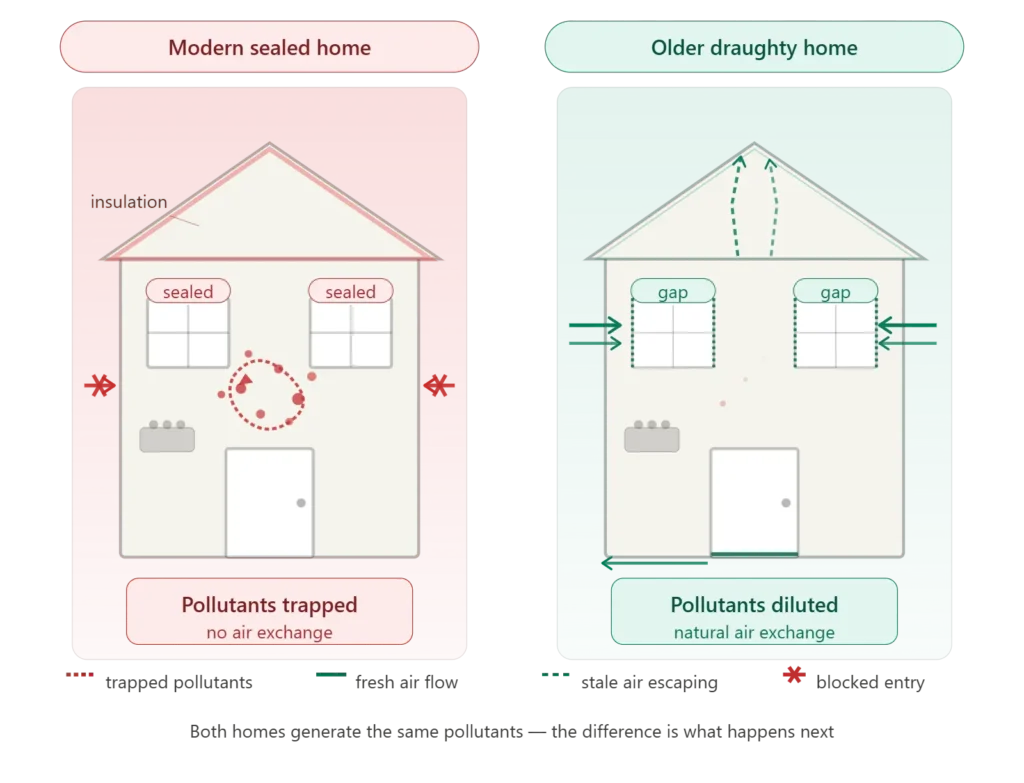
Today’s homes are better sealed, better insulated, and more airtight than ever before. This is great for heating and cooling bills. For air quality, it creates a serious problem.
Older homes naturally “breathed.” Small gaps around windows, doors, and foundations allowed indoor and outdoor air to mix, diluting whatever pollutants built up inside. It wasn’t efficient, but it was functional.
Modern construction eliminates most of that natural air exchange. The result: pollutants generated inside your home — from cooking, cleaning products, furniture, flooring, and even your own breath — accumulate with nowhere to go.
Poor ventilation is now one of the leading contributors to unhealthy indoor environments, and tightly sealed, energy-efficient homes are among the most at risk.
The Hidden Sources of Indoor Air Pollution
Most people assume indoor air pollution comes from obvious sources — mould, cigarette smoke, or maybe an old furnace. The reality is far more diverse, and much of it is happening during completely ordinary daily activities.
Cooking
Frying, grilling, broiling, and searing food releases fine particulate matter directly into your home’s air. These particles are small enough to travel deep into the lungs, and they don’t require burning or charring to form — even a pan of vegetables sautéing in oil generates them.
Research published in journals like Environmental Science & Technology has found that cooking without ventilation can push indoor particle levels well above EPA outdoor air quality standards, sometimes within minutes.
The fix is straightforward: run your range hood, open a window, or run an air purifier in the kitchen. But most households don’t do this consistently because nobody has connected dinner preparation to air quality.
Cleaning Products
Many conventional cleaning sprays, disinfectants, and air fresheners release volatile organic compounds (VOCs) — chemicals that vaporise at room temperature and linger in indoor air long after the product has been put away.
Ironically, a freshly cleaned home can temporarily have worse air quality than before cleaning began. This is not an argument against cleaning. It is an argument for ventilating during and after, and where possible, choosing products with simpler ingredient lists.
Furniture, Flooring, and Building Materials
New furniture and flooring — particularly products made from composite wood, foam, or synthetic materials — often off-gas formaldehyde and other VOCs for months or even years after installation.
That “new furniture smell” is not neutral. It’s a chemical signature of off-gassing, and it tends to be most concentrated in the first weeks after purchase.
Everyday Biological Sources
Carbon dioxide from breathing accumulates naturally in occupied, unventilated spaces. Dust mites, pet dander, and mould spores are biological pollutants that thrive in homes with poor airflow, excess humidity, or both.
These aren’t exotic threats. They’re present in most homes at some level. The question is whether the ventilation in your home is keeping them in check.

Concerned about what else might be lurking in your home environment?
Read our related post: Common Toxins in Homes: Hidden Sources and Simple Ways to Reduce Exposure
Exposure Time: The Factor That’s Left Out of Most Discussions
A lot of conversations about air quality focus on pollution levels. What’s missing — almost always — is a discussion of exposure duration.
These two factors are inseparable. A low-level pollutant encountered for eight hours every night has an entirely different health profile than a higher-level pollutant breathed for ten minutes on a morning jog.
Consider the bedroom. Most people spend seven to nine hours there every night. If that room has poor airflow, elevated carbon dioxide (which rises naturally as you sleep in an enclosed space), or high allergen levels, you’re experiencing that environment for a third of your life.
That chronic exposure rarely triggers dramatic symptoms. Instead, it tends to show up as fatigue, difficulty concentrating, low-grade congestion, or restless sleep — symptoms that are easy to attribute to stress, screens, or diet, and almost never connected to the room itself.
How Indoor Air Quality Affects More Than Your Breathing
The lung-centric view of air quality misses a significant part of the picture.
Research from Harvard’s T.H. Chan School of Public Health has found that cognitive performance — including response times, decision-making, and focus — declines measurably in poorly ventilated environments with elevated CO₂ levels. Office workers, students, and remote workers spending long hours in sealed rooms may be experiencing meaningful cognitive impacts without ever realizing it.
Sleep is another area increasingly linked to indoor air quality. Elevated CO₂, allergens, and humidity imbalances in bedrooms can disrupt sleep architecture — not necessarily causing insomnia but reducing the restorative quality of sleep even when total hours appear normal.
Other research has explored connections between indoor pollutant exposure and mood regulation, immune function, and long-term respiratory health. None of this is settled science, and individual variation is significant. But the emerging picture is consistent: indoor air quality is a whole-body issue, not just a breathing issue.
Children Are More Vulnerable — Here’s Why
Children’s bodies are not simply smaller versions of adult bodies when it comes to environmental exposure. They breathe more air relative to their body weight. Their organs are still developing. Their immune systems are still calibrating.
Children also spend more time close to the floor, where heavier particles — dust, allergens, off-gassed compounds — tend to settle in higher concentrations.
A child doesn’t need to have asthma or an existing respiratory condition for indoor air quality to be relevant to their health. Cleaner indoor environments support healthy development, better sleep, and improved concentration — all of which matter enormously during childhood.

Why “Clean-Smelling” Doesn’t Mean Clean Air
Consumer marketing has done an exceptionally effective job of convincing people that clean air smells like something: pine, citrus, fresh linen, ocean breeze.
This is one of the more consequential myths in home health.
Many air fresheners, scented candles, and plug-in diffusers work by adding fragrance molecules to the air — some of which are VOCs that can themselves be air quality concerns. They don’t remove pollutants. They layer scent on top of them.
The result is air that smells pleasant but may carry more chemical load than unscented, well-ventilated air.
Odour is an extremely poor proxy for air quality. Some of the most serious indoor pollutants — carbon monoxide, radon, formaldehyde — are entirely odourless. Others are masked so effectively by fragrances that people assume the problem has been solved when it hasn’t.
The cleanest indoor air often has almost no smell at all.
Practical Steps That Actually Make a Difference
Improving indoor air quality doesn’t require a costly renovation. Most impactful changes fall into one of three categories:
Ventilation Open windows when outdoor air quality allows. Run exhaust fans during cooking and bathing. Consider an energy recovery ventilator (ERV) if you live in a tightly sealed home in a climate that makes regular window ventilation impractical.
Source Reduction Choose low-VOC paints, flooring, and furniture where possible. Air out new purchases before bringing them inside. Switch to unscented or fragrance-free cleaning products. Store chemicals and solvents outside the main living space.
Filtration Portable air purifiers with HEPA filters are effective at reducing particulate matter, allergens, and some biological pollutants. They work best in the rooms where you spend the most time — particularly bedrooms.
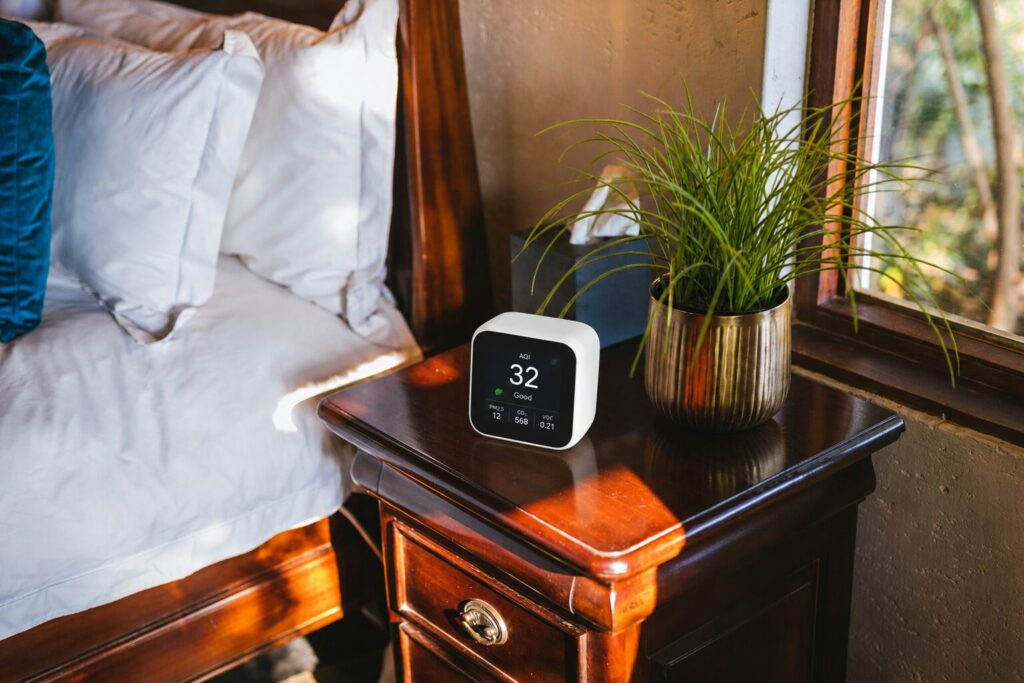
Monitoring Affordable indoor air quality monitors now track particulate matter, VOCs, CO₂, humidity, and temperature in real time. Knowing what’s actually in your air is the first step toward doing something about it.
The Bigger Picture
We’ve spent decades improving what we eat, how we move, and how we sleep. These are all important. But we breathe roughly 20,000 times every day, and almost none of those breaths happen outdoors.
The environments we occupy most — our homes, our bedrooms, our children’s rooms — shape our health in ways that are cumulative, largely invisible, and almost entirely within our control.
That’s a meaningful opportunity.
Indoor air quality is no longer a niche concern for people with allergies or asthma. It’s a mainstream health issue, and the conversation is just beginning.