Your Home, Your Food, Your Planet: The Case for a Holistic Sustainable Lifestyle
Most of us think about sustainability, nutrition, and housing as separate challenges. They are not. The way we eat, where we live, and how we build our homes form an interconnected system — and understanding that connection is an important step toward living more holistic sustainable lifestyle.
Table of Contents
Why These Three Pillars are Inseparable
The concept of sustainable living has evolved far beyond solar panels and reusable bags. Researchers, urban planners, and public health experts now agree: you cannot fully address one pillar — sustainability, nutrition, or housing — without affecting the other two. They are, in every meaningful sense, a system.
Consider this: the food system is responsible for approximately a third of global greenhouse gas emissions, while the built environment — our homes and buildings — accounts for nearly 40% of global energy consumption. At the same time, where and how people live directly determines what food they can access, afford, and prepare. The loop closes on itself constantly.
~ 33%
of global GHG emissions linked to food systems
~ 40%
of global energy use attributed to buildings
~ 70%
of freshwater withdrawals driven by agriculture
These numbers are not abstractions. They describe the daily reality of billions of people whose health, comfort, and food security are all shaped by the same underlying decisions — made by individuals, communities, and governments alike.
How Housing Shapes What — and How — We Eat
Your home is not just where you sleep. It is where food is stored, prepared, composted, or wasted.
The design and quality of your living space has a measurable impact on your nutritional habits and, by extension, on the environment.
The environment you live in shapes your body in ways that go well beyond what you eat or how much you exercise. Explore how environmental health directly influences your physical and mental wellbeing.
Kitchen design and cooking behaviour
Homes with well-designed kitchens — adequate counter space, functioning appliances, good ventilation — are strongly associated with higher rates of home cooking. Home-cooked meals tend to be more nutritious, generate less packaging waste, and rely less on ultra-processed foods.
This is not a lifestyle preference; it is a structural outcome shaped by housing quality.
Food storage and waste
Poorly insulated homes create conditions where food spoils faster, in overcrowded houses fridges are shared across too many people, and storage space is scarce.
Poor food systems and health outcomes often trace back to inadequate housing infrastructure — not just to individual choices.
Energy insecurity and meal preparation
Households struggling with energy poverty — unable to reliably heat their homes or power appliances — often resort to meals that require minimal cooking: highly processed, low-nutrient, high-sodium convenience foods.
Green housing, by reducing energy costs through better insulation, passive design, and renewable energy, directly improves the conditions under which families prepare and consume food.
Sustainable housing research increasingly frames energy efficiency not just as a climate intervention, but as a public health one. Lower energy bills mean more household budget available for nutritious food. Better ventilation means safer indoor air quality during cooking.
If this has you rethinking your living space, the good news is that building or adapting a greener home is more achievable than it sounds. Here are 20+ features of a truly eco-friendly home — and why each one matters.

The Environmental Cost of What We Eat
Nutrition sits at the centre of the sustainability crisis in ways that are still underappreciated. The 2025 EAT–Lancet Commission confirmed what researchers have argued for years: dietary change is the single most effective lever individuals have for reducing their personal environmental footprint.
An eco-friendly diet — one rich in plant-based foods, low in animal products, and locally or regeneratively sourced — can dramatically reduce greenhouse gas emissions, water use, and land pressure. It can also improve long-term health outcomes, lowering the risk of cardiovascular disease, type 2 diabetes, and certain cancers.
But to understand why food choices carry such enormous environmental weight, it helps to look at three specific pressure points: what raising animals costs the planet, how much food disappears before it ever reaches a plate, and what is quietly happening beneath our feet.
The true cost of meat on a planetary scale
Animal agriculture is responsible for more than three-quarters of agricultural land use, between 11% and 20% of global greenhouse gas emissions, and more than 30% of global methane emissions. These are not marginal contributions — they are structural ones, baked into the way the global food system has been built over decades.
Livestock supply chains account for 14.5% of all human-induced greenhouse gas emissions, generating approximately 7.1 gigatons of CO₂ equivalent annually. Of these, cattle are the dominant driver: cattle production is responsible for 65% of emissions from the livestock sector, largely because ruminants produce methane gas during digestion — a gas that is 30 times more potent than CO₂ at trapping heat.
The land footprint tells an equally stark story. To raise animals and grow their feed, large areas of land are cleared, often through deforestation — releasing stored carbon into the atmosphere and destroying natural habitats, accelerating biodiversity loss. At the same time, research published in the Review of Environmental Economics and Policy suggests that the retail price of meat in high-income countries would need to rise by 35–56% for beef and around 25% for poultry just to account for the environmental damage already caused by its production — a cost that currently falls on the planet rather than the consumer.
This does not mean meat must disappear from the table entirely. But it does mean that any serious commitment to a holistic sustainable lifestyle requires rethinking how much of it we eat, where it comes from, and how it was raised.

Food loss along the farming and supply chain
The environmental damage caused by food does not begin at the dinner table. A significant share of what is grown never reaches a consumer at all — and the ecological cost of that loss is enormous.
A 2023 peer-reviewed study estimated the land footprint associated with food loss worldwide at an average of 69 million hectares per year — an area larger than France — consumed entirely to produce food that is lost during production, post-harvest handling, processing, and transport. This figure, from Eduardo Botti Abbade’s work published in the Journal of the Science of Food and Agriculture, makes clear that food loss is not simply a logistical inefficiency. It is an environmental crisis embedded in the supply chain itself.
In 2021, 13.2% of global food production was lost during post-harvest stages of transport, storage, wholesale, and processing alone. These are systemic losses rooted in infrastructure gaps, inadequate cold chains, and the pressures of industrial-scale farming — particularly acute in lower-income regions where post-harvest technology is limited.
Food loss and waste together account for up to 10% of global greenhouse gas emissions — nearly five times the emissions from the entire aviation sector — and up to 14% of global methane emissions.
Reducing these losses, therefore, is not a secondary climate action. It is one of the most direct levers available to bring food systems into alignment with planetary boundaries.

Why soil health is the foundation of everything
Beneath every conversation about sustainable food and environmental nutrition lies a medium most people never see: soil. Healthy soil is not just dirt — it is a living ecosystem, teeming with microbial life, fungi, and organic matter that determines how nutritious our food is, how much carbon is stored in the ground, and how resilient farming systems are to climate disruption.
Industrial agriculture practices — including herbicide and pesticide use, synthetic fertilizer application, large-scale monocropping, and tillage — contribute to rising atmospheric CO₂, damage water resources through nutrient pollution and soil erosion, and significantly reduce biodiversity across ecosystems. The more degraded the soil, the less nutritious the food it produces, and the more inputs are needed to grow it — a feedback loop that accelerates environmental harm while quietly depleting the quality of the food supply.
Regenerative agriculture offers a measurable alternative. A 2025 narrative review published in Antioxidants found that regenerative organic practices — including crop rotation, cover cropping, and minimal tillage — enhance phytochemical content and reduce harmful residues in plant foods, with empirical studies reporting increases in vitamin C, zinc, and polyphenols in crops such as leafy greens, grapes, and carrots grown under regenerative systems.
A 2024 paper in Frontiers in Nutrition exploring the intersection of food-as-medicine and regenerative agriculture concluded that improving soil health through these methods restores both ecosystem function and human health simultaneously — making truly sustainable food not just better for the planet, but measurably more nutritious. The soil, it turns out, is where environmental health and human health converge most directly.

What is environmental nutrition? Environmental nutrition is an emerging discipline that examines how our food choices affect both human health and ecological systems. It reframes the dinner table as a site of environmental action — not just personal wellness. Choosing lentils over beef, or buying from a regenerative local farm, is simultaneously a health decision and a climate decision.
Green Housing as a Foundation for Healthier Lives
A growing body of peer-reviewed research now frames green housing as a social determinant of health — not merely a climate strategy. Sustainable homes built with low-carbon materials, passive design principles, efficient heating and cooling systems, and access to green outdoor space produce measurable improvements in physical and mental health outcomes.
Indoor air quality and nutrition
Poor ventilation in homes leads to indoor air pollution from cooking fumes, mould, and volatile organic compounds — all of which affect respiratory health. When cooking itself becomes a health risk, people are less likely to cook from scratch. Green homes, designed with proper airflow and non-toxic materials, remove this barrier entirely.
Read our full breakdown of indoor air pollution and what you can do about it.
Access to green space and food growing
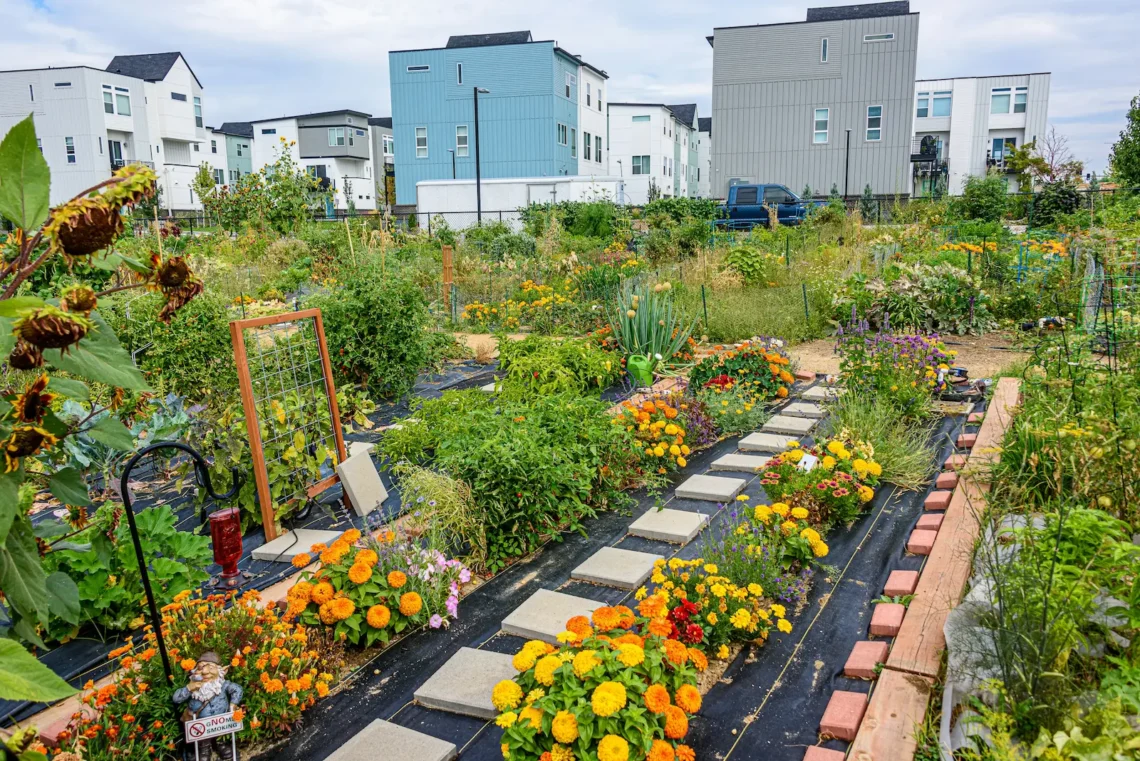
Sustainable urban housing increasingly incorporates communal gardens, green rooftops, and proximity to local food systems. Research links access to these spaces with higher fruit and vegetable consumption, improved mental health, and stronger community cohesion. Where you live determines not just your shelter, but your relationship to food and nature.
Affordability as a sustainability lever
This is perhaps the most under-discussed connection: affordable, energy-efficient housing frees up household income. When families spend less on heating, cooling, and maintenance, they have more to spend on quality food. The sustainability of a home is not separate from nutritional wellbeing — it directly funds it.
A 2025 literature review published in the journal Sustainability concluded that integrating sustainable housing into public health frameworks can reduce health inequities, mitigate chronic disease risks, and promote resilient urban futures. The researchers noted that housing quality affects everything from diet to mental health to lifespan — particularly for marginalised and low-income communities.
The policy dimension: why systemic change matters
Individual action is meaningful. But the connection between sustainability, nutrition, and housing is also a policy challenge.
Zoning laws shape whether grocery stores or fast-food chains are built near new housing developments. Building codes determine whether new homes are energy efficient or not. Agricultural subsidies influence what foods are cheap and abundant.
Agri-food systems directly or indirectly influence at least 16 of the 17 Sustainable Development Goals — a finding consistently cited across international science-policy frameworks, including the UN FAO. The 2025 Frontiers in Sustainable Food Systems editorial makes clear that integrated approaches — spanning food, health, equity, and environmental resilience — are no longer optional. They are essential.
Advocates for sustainable living are increasingly pushing for joined-up policy: urban agriculture incentives, green building mandates, school nutrition programs tied to local food procurement, and energy-efficiency retrofits for low-income housing.
These are not separate agendas. They are the same agenda, expressed in different rooms.
The planet you dreamed of starts at home
The sustainable living triangle — your home, your food, your planet — is not a metaphor. It is a practical, measurable, scientifically documented reality.
The materials your walls are made of affect your energy bill. Your energy bill affects what you eat. What you eat affects the soil, the water, the air, and the climate that makes housing possible in the first place.
Understanding these connections does not make individual action feel smaller. It makes it feel more meaningful.
Every choice about where to live, what to eat, and how to build is a choice about the kind of planet we leave behind.
And that is exactly the planet we dreamed of.