Sustainable Living Explained: What It Really Means (And What It Doesn’t)
Sustainable living has become one of the defining conversations of modern life.
We see it in discussions about food, homes, energy, gardening, transport, consumption, climate, and community. It appears in social media feeds, policy debates, documentaries, and marketing campaigns. Yet despite how often the phrase is used, many people are still left wondering what sustainable living actually means in practice.
For some, it evokes images of off-grid cabins, zero-waste perfection, or expensive eco-friendly products. For others, it can feel overwhelming — another reminder that modern life is already demanding enough.
But sustainable living is not about perfection.
It is not about guilt, purity, or transforming your entire life overnight.
At its core, sustainable living is a thoughtful approach to living well while reducing unnecessary harm to the environment, supporting healthier communities, and protecting resources for future generations.
In many ways, it is less about doing everything perfectly and more about becoming more conscious of the systems we participate in every day.
The food we buy. The homes we build. The energy we use. The way we consume, travel, grow, repair, waste, and connect.
Sustainable living invites us to slow down enough to ask better questions about those choices.
Not from a place of fear. But from a place of awareness, responsibility, and possibility.
This guide explores what sustainable living really means, the principles behind it, the misconceptions that often surround it, and the practical ways it shapes everyday life. Whether you are just beginning to explore sustainability or looking to deepen your understanding, the goal is not to offer rigid rules.
It is to offer a grounded framework for living more intentionally in a rapidly changing world.
Table of Contents
What Is Sustainable Living in Simple Terms?
Sustainable living means making choices that reduce unnecessary environmental harm while supporting long-term well-being for people, communities, and ecosystems.
In practice, this often involves:
- Using resources more thoughtfully
- Reducing waste and overconsumption
- Conserving energy and water
- Supporting healthier food systems
- Choosing durable and ethical products
- Strengthening local communities
- Thinking long-term rather than short-term
Sustainable living is not one specific lifestyle.
It can look different depending on where you live, your income, your culture, your access to resources, and your personal values. Someone living sustainably in a city apartment may make very different choices from someone living on a rural property or homestead.
What matters most is not perfection, but intention.
At its heart, sustainable living is about creating ways of living that can endure — environmentally, socially, and economically — without exhausting the systems that support life itself.
Why Sustainable Living Matters More Than Ever
Modern life has brought extraordinary convenience, speed, and abundance.
But it has also created systems built around constant extraction, rapid consumption, and short-term thinking.
Many of the environmental challenges we face today — climate change, pollution, biodiversity loss, soil degradation, and resource depletion — are deeply connected to the way modern societies produce and consume.
At the same time, many people are also feeling the personal effects of these systems in quieter ways:
- Burnout from fast-paced lifestyles
- Disconnection from nature and community
- Rising living costs
- Disposable consumer culture
- Increasing waste and clutter
- A growing sense that modern life often feels unsustainable on a human level too
This is part of why sustainable living resonates with so many people.
Not because everyone wants to live off-grid or become perfectly zero-waste.
But because many people are searching for more balanced, resilient, and meaningful ways to live.
Sustainability is ultimately about relationships.
Our relationship with the environment. Our relationship with consumption. Our relationship with community. And our relationship with the future.
Rather than treating sustainability as a restrictive set of rules, it can be more helpful to see it as a long-term mindset rooted in stewardship, care, and practical responsibility.

The Core Principles of Sustainable Living
Although sustainable living can take many forms, several core principles appear consistently across sustainability research, environmental design, regenerative agriculture, and community resilience practices.
These principles help create a useful framework for understanding what sustainability looks like in everyday life.
1. Reduce Unnecessary Consumption
One of the simplest and most powerful ideas within sustainable living is learning to consume more intentionally.
Modern economies are often built around continuous consumption — buying, replacing, upgrading, and discarding at an accelerating pace. Sustainable living challenges the assumption that more consumption automatically creates a better quality of life.
This does not mean rejecting comfort or convenience altogether.
It means becoming more mindful about what we truly need, what adds value to our lives, and what unnecessary consumption costs environmentally and socially.
In practice, this can look like:
- Buying fewer but higher-quality products
- Repairing instead of replacing
- Avoiding impulse purchases
- Choosing durable materials
- Reducing single-use items
- Being more conscious of packaging and waste
Very often, sustainable living begins not with dramatic lifestyle changes, but with greater awareness.
2. Conserve Energy and Natural Resources
Sustainable living also involves using resources efficiently and responsibly.
Energy, water, soil, forests, minerals, and biodiversity are all interconnected systems that support human life. Many of these resources are under growing pressure due to overuse and environmental degradation.
Conservation is not about deprivation.
It is about reducing unnecessary waste while designing systems that work more efficiently.
This principle can influence:
- Energy-efficient homes
- Water-saving practices
- Sustainable landscaping
- Renewable energy systems
- Better insulation and passive design
- Efficient appliances and lighting
Often, the most sustainable systems are not the most complicated. They are simply the most thoughtful.
3. Support Regenerative and Local Systems
Sustainable living is not only about reducing harm. Increasingly, it is also about regeneration.
Regenerative approaches aim to restore ecosystems, strengthen communities, rebuild soil health, improve biodiversity, and create systems that become healthier over time rather than more depleted.
This is especially visible in areas like:
- Regenerative agriculture
- Sustainable gardening
- Ecological landscaping
- Community food systems
- Local economies
- Circular design systems
Supporting local farmers, growers, tradespeople, and small businesses can also reduce transportation impacts while helping communities become more resilient and connected.
For many people, sustainability becomes more meaningful when it moves beyond individual consumption habits and begins reconnecting them to place, seasonality, and community.
4. Reduce Waste and Pollution
Modern waste systems generate enormous environmental pressure.
Plastic pollution, food waste, textile waste, construction waste, and electronic waste all contribute to landfill expansion, pollution, and resource depletion.
Sustainable living encourages reducing waste at the source whenever possible.
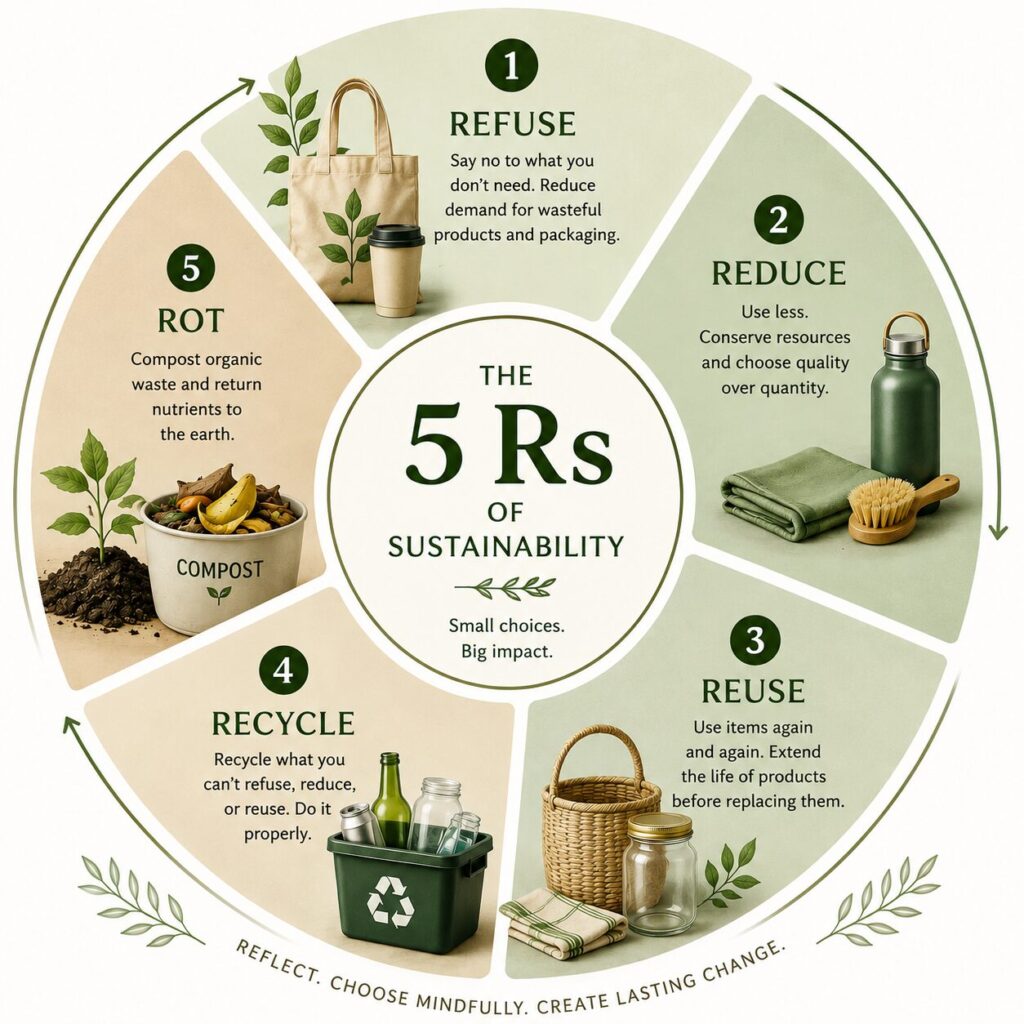
A commonly used framework is the “5 Rs”:
- Reduce what you consume
- Reuse what you can
- Recycle correctly
- Rot organic waste through composting
While recycling remains important, many sustainability experts now emphasize that reducing unnecessary consumption upstream has a far greater long-term impact.
5. Think Long-Term
Perhaps the defining principle of sustainable living is long-term thinking.
Many modern systems prioritize immediate convenience and short-term economic gain, often while externalizing environmental costs into the future.
Sustainability asks a different question:
How can we meet present needs without compromising the ability of future generations to meet theirs?
That question influences everything from urban planning and agriculture to housing, energy, transport, and consumer culture.
Long-term thinking encourages durability over disposability, resilience over short-term efficiency, and stewardship over extraction.
What Sustainable Living Is Not
One of the reasons sustainable living can feel intimidating is because it is often misunderstood.
Online, sustainability is sometimes presented as either an aesthetic identity or an impossible standard of moral perfection.
In reality, sustainable living is far more practical — and far more human — than that.
Sustainable Living Is Not About Perfection
You do not need to produce zero waste, grow all your own food, or eliminate every unsustainable habit from your life.
Perfectionism often becomes one of the biggest barriers to sustainable action.
Many people feel overwhelmed because they believe sustainability only “counts” if they do everything correctly all at once. But meaningful environmental progress rarely happens through perfection.
It happens through millions of gradual, imperfect decisions made consistently over time.
Sustainable living is not about becoming flawless.
It is about becoming more conscious.
It Is Not About Constant Sacrifice
There is a common misconception that sustainability requires giving up comfort, beauty, joy, or convenience.
In reality, many sustainable practices improve quality of life rather than diminish it.
Growing food, spending more time outdoors, reducing clutter, improving home efficiency, supporting local businesses, walking more, cooking more intentionally, and creating healthier living environments can often feel deeply rewarding.
Sustainability is not about making life smaller.
Often, it is about making life more connected and intentional.
It Is Not One-Size-Fits-All
A sustainable lifestyle will look different for different people.
Someone living in a dense city may rely heavily on public transportation and apartment living. Someone in a rural environment may focus more on gardening, water management, food production, or ecological land stewardship.
Income, geography, family structure, housing access, health, infrastructure, and cultural context all influence what sustainability looks like in practice.
This is why rigid purity standards are rarely helpful.
The goal is not to create identical lifestyles. The goal is to create healthier systems and more thoughtful patterns of living.
It Is Not Just About Individual Responsibility
Individual choices matter.
But sustainability is also deeply connected to larger systems — including infrastructure, policy, urban design, agriculture, manufacturing, and energy production.
People can only make sustainable choices consistently when sustainable options are accessible, affordable, and supported structurally.
This is why conversations about sustainability increasingly include:
- Renewable energy infrastructure
- Public transportation
- Sustainable housing design
- Regenerative agriculture
- Circular economies
- Community resilience
- Environmental policy
Individual action matters most when it becomes part of broader cultural and systemic change.
It Is Not About Buying an Entirely New Lifestyle
Ironically, consumer culture has found ways to market sustainability through endless purchasing.
Eco-friendly products can absolutely be useful and valuable. But sustainable living is not about replacing every item you own with a more aesthetically pleasing “green” version.
Very often, the most sustainable choice is:
- Using what you already have
- Repairing what still works
- Buying less overall
- Choosing durability over trends
Sustainability is not another form of hyper-consumerism.
It is, in many ways, a response to it.
The Main Areas of Sustainable Living
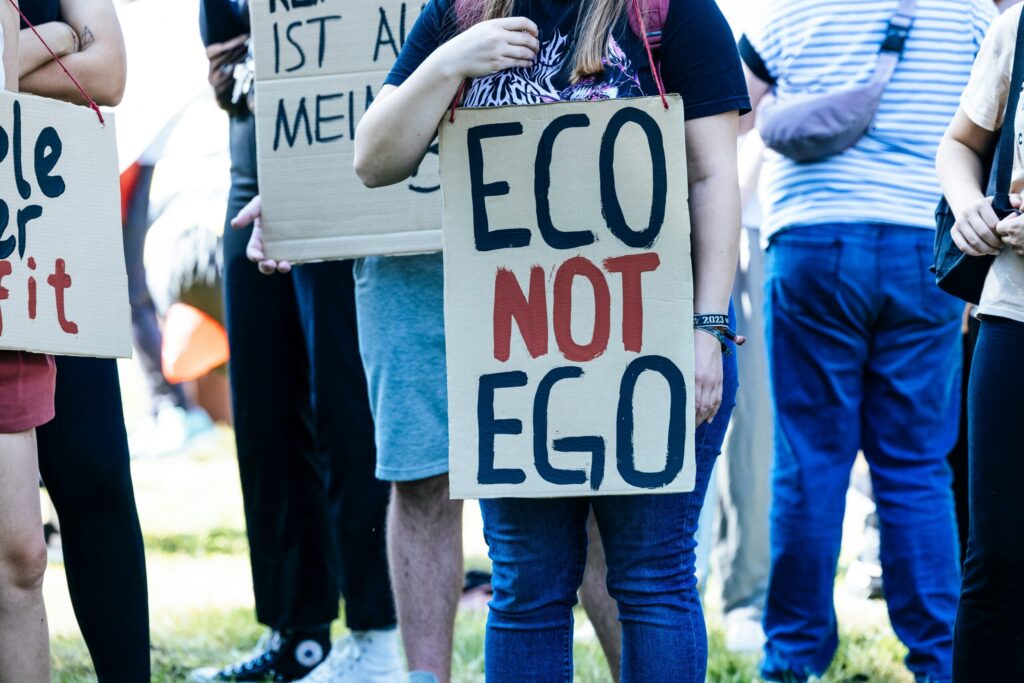
Sustainable living touches nearly every aspect of modern life. However, several areas tend to have the greatest environmental and practical impact.
These areas also form the foundation for many sustainable lifestyle choices.
Sustainable Housing and Building
Homes shape energy use, water consumption, material use, waste generation, and long-term environmental impact.
Traditional construction systems often rely heavily on resource-intensive materials and inefficient design.
Sustainable housing aims to create living spaces that are healthier, more energy efficient, and better adapted to long-term environmental realities.
Importantly, sustainable housing does not always mean building a cutting-edge eco-home from scratch.
For most people, sustainability begins with improving the efficiency and durability of existing spaces.
Some common sustainable home improvements include:
- Better insulation
- Energy-efficient windows
- LED lighting
- Natural ventilation
- Water-saving fixtures
- Durable building materials
- Low-toxicity paints and finishes
- Passive solar design principles
Passive design is especially important in sustainable architecture.
Rather than relying heavily on mechanical heating and cooling systems, passive homes are designed to work with natural sunlight, airflow, orientation, and thermal performance. This reduces energy demand while improving comfort.
Smaller homes, modular construction, adaptive reuse, and ecological landscaping are also becoming increasingly important conversations within sustainable building.
The future of sustainable housing is not simply about technology.
It is about designing spaces that are efficient, resilient, healthy, and deeply connected to the environments around them.

Energy Use and Efficiency
Energy consumption remains one of the largest contributors to global greenhouse gas emissions.
Much of the world still depends heavily on fossil fuels such as coal, oil, and natural gas. Sustainable living encourages both reducing unnecessary energy demand and supporting cleaner renewable energy systems.
One encouraging reality is that energy efficiency is often one of the most accessible entry points into sustainability.
Small actions can create meaningful cumulative impact over time.
Examples include:
- Switching to LED lighting
- Using energy-efficient appliances
- Improving insulation
- Turning off unused electronics
- Washing clothes in cold water
- Using smart thermostats
- Reducing standby power use
Renewable energy systems such as solar and wind power are also becoming increasingly important as societies transition toward lower-carbon infrastructure.
For homeowners, solar panels may provide long-term savings alongside environmental benefits. For renters and urban residents, supporting renewable energy providers or community energy initiatives can also contribute to broader energy transitions.
Transportation is closely connected to energy use as well.
Walking, cycling, public transport, electric vehicles, remote work, and more walkable urban design all play important roles in reducing transport emissions.
Sustainable energy systems are ultimately about more than lowering carbon emissions.
They are also about creating healthier, more resilient communities that are less dependent on unstable and extractive energy systems.

Sustainable Food Systems
Food is one of the most personal and visible parts of sustainable living.
Every meal connects individuals to larger systems involving agriculture, soil, water, transport, labor, biodiversity, and waste.
Industrial food systems have dramatically increased food production, but they have also contributed to environmental challenges including deforestation, soil degradation, excessive pesticide use, water depletion, and greenhouse gas emissions.
Sustainable food systems aim to create healthier relationships between food, people, and ecosystems.
This often includes:
- Local food production
- Seasonal eating
- Regenerative agriculture
- Organic growing practices
- Reduced food waste
- Ethical treatment of animals
- Greater biodiversity
- More resilient regional food systems
Importantly, sustainable eating does not require rigid dietary purity.
For many people, sustainability begins with small shifts:
- Cooking more meals at home
- Buying local produce when possible
- Reducing food waste
- Eating more plant-forward meals
- Supporting ethical growers and producers
- Growing herbs, vegetables, or fruit at home
Even simple acts like composting kitchen scraps or learning how food is grown can reconnect people to systems that modern life often makes invisible.
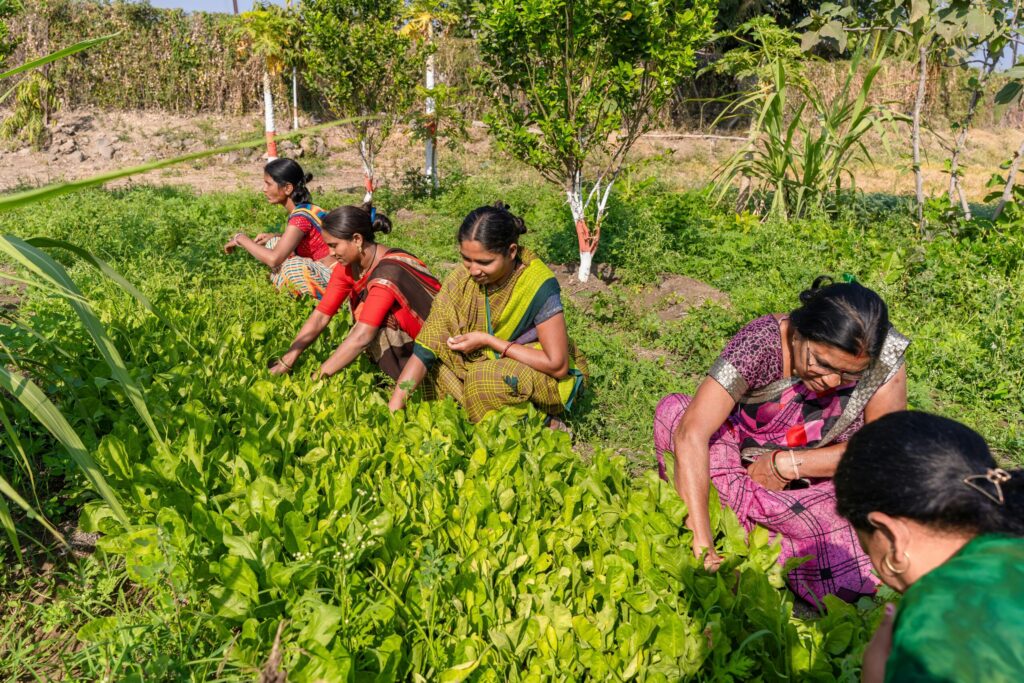
For many sustainability enthusiasts, gardening becomes especially meaningful because it transforms sustainability from an abstract idea into something tangible and lived.
A garden teaches seasonality, patience, ecology, soil health, biodiversity, and interdependence in ways that few other experiences can.
Water Conservation and Stewardship
Fresh water is one of the planet’s most essential resources, yet many regions face increasing pressure from pollution, overuse, drought, and climate instability.
Sustainable living encourages using water more thoughtfully while protecting water systems for future generations.
Many everyday activities require more water than people realize:
- Food production
- Laundry
- Showers
- Landscaping
- Manufacturing
- Household cleaning
Fortunately, water conservation often begins with relatively simple habits.
These may include:
- Fixing leaks quickly
- Using efficient fixtures
- Collecting rainwater
- Running full laundry loads
- Shortening showers
- Choosing drought-tolerant plants
- Improving irrigation efficiency
Sustainable landscaping plays an increasingly important role in water stewardship.
Native plants, regenerative soil practices, mulching, rain gardens, and ecological landscape design can dramatically reduce water demand while supporting biodiversity.
Water sustainability is ultimately about understanding that clean fresh water is not an infinite resource.
Protecting it requires both personal responsibility and larger systemic planning.

Consumption, Waste, and Materials
Modern consumer culture often encourages constant replacement.
Products are frequently designed for convenience, speed, and short-term use rather than durability or repairability.
This creates enormous amounts of waste while placing heavy pressure on natural resources.
Sustainable living challenges the assumption that fulfillment comes through endless consumption.
Instead, it encourages more conscious relationships with the things we buy, use, repair, and discard.
This can include:
- Buying fewer, higher-quality items
- Supporting ethical brands
- Choosing reusable products
- Repairing instead of replacing
- Shopping secondhand
- Avoiding excessive packaging
- Composting organic waste
Plastic pollution has become one of the most visible examples of unsustainable consumption.
Single-use plastics often remain in ecosystems for hundreds of years, affecting oceans, wildlife, and food systems.
Simple alternatives such as reusable bags, containers, bottles, and durable household products can significantly reduce waste over time.
Fast fashion is another major sustainability issue.
The clothing industry consumes enormous quantities of water and energy while generating significant textile waste.
Sustainable fashion encourages durability, ethical production, secondhand purchasing, and more thoughtful consumption habits.
Ultimately, sustainable consumption is not about living with as little as possible.
It is about becoming more intentional about what enters our lives and what impact those choices create.
The Benefits of Sustainable Living
Sustainable living is often discussed in environmental terms, but its benefits extend much further.
Many sustainable practices also support personal well-being, financial resilience, healthier communities, and improved quality of life.
Health and Well-Being
Many sustainable habits naturally align with healthier living.
Walking more, gardening, eating less processed food, spending time outdoors, improving indoor air quality, and reducing exposure to toxins can all positively influence physical and mental well-being.
There is also growing research around the psychological benefits of stronger connections with nature and community.
For many people, sustainability is not simply about reducing environmental impact.
It is also about creating a slower, healthier, more grounded relationship with everyday life.
Financial Resilience
Contrary to popular belief, sustainable living is not always more expensive.
While some sustainable technologies involve higher upfront costs, many sustainable habits reduce expenses over time.
Examples include:
- Lower energy bills through efficiency
- Reduced waste and unnecessary purchases
- Durable products that last longer
- Growing food at home
- Repairing rather than replacing
- Using fewer disposable items
Sustainability often aligns surprisingly well with long-term financial resilience because it prioritizes efficiency, durability, and thoughtful consumption.
Stronger Communities
Sustainable living also encourages more localized and resilient communities.
Supporting local growers, farmers markets, independent tradespeople, repair culture, and community initiatives helps strengthen local economies while reducing reliance on fragile global systems.
Shared gardens, tool libraries, seed exchanges, and neighborhood projects also create stronger social connections.
In a world that often feels increasingly fragmented and isolated, this sense of connection matters.
Greater Long-Term Resilience
One of the most important benefits of sustainability is resilience.
Efficient homes, renewable energy systems, regenerative landscapes, local food systems, durable infrastructure, and stronger communities all help societies adapt more effectively to economic, environmental, and climate-related challenges.
Sustainability is not only about reducing harm today.
It is also about creating systems capable of supporting life well into the future.
Is Sustainable Living Expensive?
One of the most persistent myths about sustainability is that it is only accessible to wealthy households.
Luxury eco-homes, designer “green” products, and expensive technology can create the impression that sustainable living requires significant financial privilege.
The reality is far more nuanced.
Some sustainable investments do involve upfront costs. Solar panels, efficient home upgrades, and certain ethical products may initially cost more.
However, sustainability is not fundamentally about spending more.
It is about using resources more intentionally.
Many sustainable practices are low-cost or even cost-saving over time:
- Buying less overall
- Reducing food waste
- Using less energy and water
- Repairing products
- Shopping secondhand
- Growing food
- Choosing durability over disposability
In many ways, sustainable living pushes back against the idea that constant consumption is necessary for a good life.
Accessibility still matters deeply.
Not everyone has equal access to renewable energy, efficient housing, organic food, public transportation, or green infrastructure. This is why sustainability conversations must include affordability, accessibility, urban planning, and policy — not just personal responsibility.
Sustainability becomes most powerful when sustainable choices are made easier and more accessible for everyone.
Sustainable Living in Practice: Where to Begin
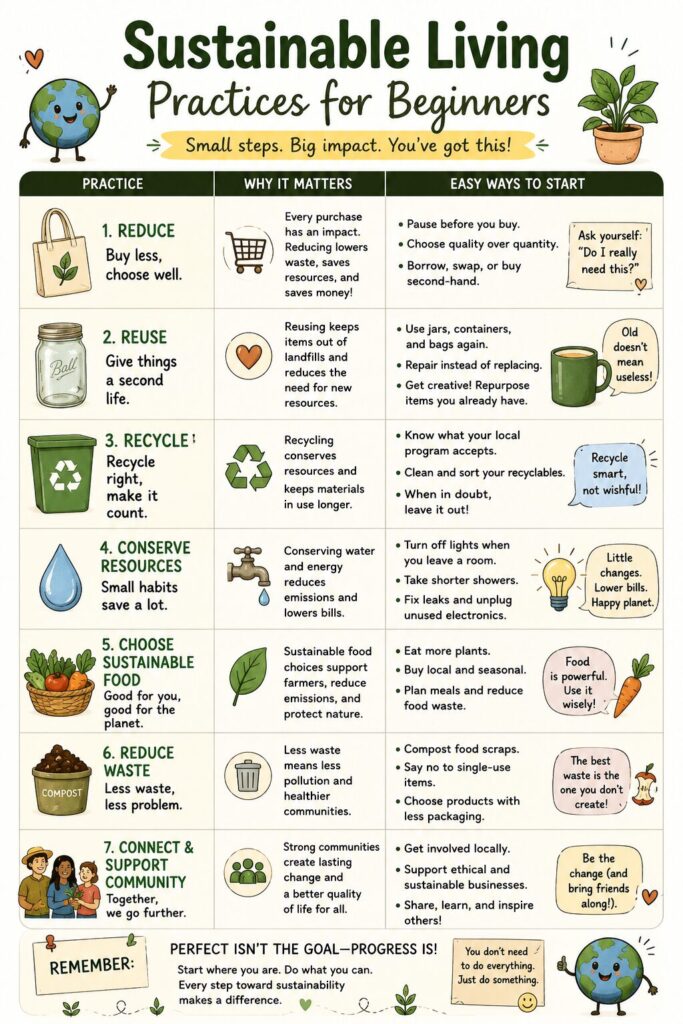
One of the biggest misconceptions about sustainable living is that it requires a complete lifestyle transformation overnight.
In reality, lasting change usually happens gradually.
The most sustainable habits are often the ones people can realistically maintain long-term.
Start With Awareness
Before changing habits, it helps to simply observe.
Where does most household waste come from? How much energy is being used unnecessarily? Which purchases are truly valuable? What areas of life feel most disconnected from sustainability goals?
Awareness often creates more meaningful long-term change than guilt ever does.
Focus on High-Impact Areas
Not all sustainability actions carry the same environmental impact.
For most households, the largest areas of impact tend to include:
- Housing and energy use
- Transportation
- Food systems
- Consumption habits
Focusing on these areas first usually creates the greatest practical and environmental benefits.
Make Small, Consistent Changes
Sustainability works best as a steady practice rather than an extreme reset.
Small actions compound over time.
This may include:
- Cooking more meals at home
- Reducing unnecessary purchases
- Improving home efficiency
- Composting food scraps
- Growing herbs or vegetables
- Choosing reusable products
- Supporting local businesses
- Spending more time outdoors
Many sustainable habits also become easier and more enjoyable once they are integrated naturally into daily routines.
Avoid Burnout and Perfectionism
Eco-anxiety and sustainability burnout are increasingly common.
The scale of environmental challenges can sometimes make individual actions feel insignificant.
But sustainable living is not about carrying the weight of every global problem alone.
It is about participating more consciously in the systems around us while recognizing that collective cultural change begins with millions of small actions, conversations, and choices.
A calmer, long-term mindset is often more sustainable than intensity.
Common Questions About Sustainable Living
Is sustainable living realistic?
Yes. Sustainable living does not require perfection or complete self-sufficiency. Most people adopt sustainability gradually through realistic changes that fit their lifestyle and circumstances.
Do I have to be vegan to live sustainably?
No. While reducing excessive meat consumption can lower environmental impact, sustainable living is broader than any single diet. Many people focus on more local, seasonal, plant-forward, or ethically sourced food choices.
Does individual action really matter?
Individual action matters most when it contributes to broader cultural and systemic change. Personal habits alone will not solve environmental problems, but collective shifts in behavior, demand, and awareness help influence industries, communities, and policy.
Is sustainable living only for rural homesteads?
Not at all. Sustainable living can be practiced in cities, suburbs, apartments, and rural areas alike. Sustainability looks different depending on environment and lifestyle.
What are the most important areas to focus on?
Housing, energy, transportation, food systems, and consumption habits tend to have the largest environmental impact for most households.
Is zero-waste living necessary?
No. Zero-waste living can be inspiring, but sustainability is not measured by perfection. Reducing waste meaningfully and consistently is far more realistic and accessible for most people.
Sustainable Living as a Long-Term Mindset
Sustainable living is not a destination that someone finally reaches.
It is an ongoing relationship with the way we move through the world.
It asks us to think more carefully about the systems we depend on, the resources we use, the communities we support, and the future we are helping shape through everyday choices.
That does not mean living perfectly.
It means paying attention.
It means recognizing that many of the small habits we often overlook — repairing something instead of discarding it, growing food, conserving water, supporting local producers, designing healthier homes, consuming more intentionally — become meaningful when practiced consistently and collectively.
Sustainable living is ultimately rooted in stewardship.
Not fear. Not guilt. Not purity.
But care.
Care for the places we live. Care for future generations. Care for the systems that quietly support life every day.
And perhaps most importantly, sustainable living reminds us that progress does not always begin with dramatic change.
Sometimes it begins quietly.
With awareness. With better questions. With slower and more thoughtful choices. With learning how to live well while leaving enough for others.
In a world increasingly shaped by speed, extraction, and constant consumption, that kind of grounded optimism may be one of the most practical forms of sustainability we have.